[01:00.26]Good afternoon and welcome to my talk on urban migration today.
[01:05.50]The world has experienced unprecedented urban growth in the recent decades.
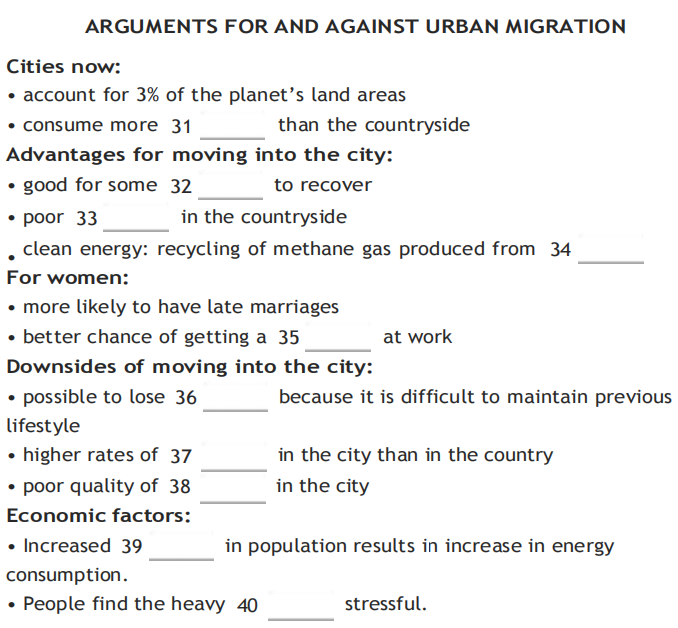
[01:11.26]As much as 3% of Earth's landmass has been urbanised, an increase of at least 50% over previous estimates.
[01:21.26]Today, people living in cities already outnumber those in rural areas and the trend does not appear to be reversing.
[01:30.70]In addition, cities have larger amounts of carbon consumption than rural areas.
[01:36.70]This is a result from two major aspects.
[01:39.78]First, with the increase of urban population around the world, the massive construction of urban infrastructure and residential housing is hard to avoid.
[01:50.98]Second, urban households have a higher rate of car ownership and use more gasoline products.
[01:59.02]Even though rural exodus is often negatively judged, there are also benefits of migration shared by the local environment and the society as a whole.
[02:10.22]Well, firstly, global trends of increasing urban migration and population urbanisation can provide opportunities for nature conservations, particularly in regions where deforestation is driven by agriculture.
[02:25.82]As rural dwellers leave their homes, local forests are left to recover.
[02:31.50]What's more, it is easier for city dwellers to get around.
[02:36.14]Living in the country means transport can be very difficult.
[02:39.74]For instance, after midnight there are no buses or taxis in the countryside.
[02:45.20]However, there is still a number of public transport modes to choose from in the city.
[02:51.20]Finally, with more funds and advanced technology, cities endeavour to produce clean energy.
[02:58.20]New power plants have been built to take harmful methane gas created by the decomposition of rubbish, and convert it into electricity.
[03:02.76]By doing so, an important greenhouse gas is turned into useful energy rather than being directly emitted into the atmosphere.
[03:18.50]The hustle and bustle of city life offers women the opportunity to explore different professions and pursue their own careers.
[03:27.82]Women in cities work as engineers, managers and even football players.
[03:33.82]This change of roles has affected their marital status and family life.
[03:39.58]More women are choosing their careers over marriage, which raises the graph of late marriages.
[03:46.46]As a result, more are remaining single well into their late thirty's.
[03:51.90]They want to be independent and earn money on their own.
[03:55.88]It is also easier for them to get a promotion while working in the city.
[04:00.60]Women are slowly achieving wider participation at work, while in rural areas the mindset is still very conservative.
[04:14.30]However, cities also change the way that humans interact with each other and the environment, often causing multiple problems.
[04:22.62]In general, urban wages are significantly higher, so moving to the city is an opportunity to earn what was impossible in rural areas.
[04:33.10]However, the wage difference is often offset by the higher cost of living and absence of self-produced goods, including subsistence farming.
[04:43.38]A sizable proportion of newcomers attach greater importance to money and gradually abandon their former way of life, thus risking losing their culture.
[04:55.56]These new city residents are also faced with another problem.
[04:59.84]According to statistics, crime rates are significantly higher in densely populated urban regions than in rural areas.
[05:08.96]For instance, property crime rates in our metropolitan areas are three to four times as high in comparison to the rates in rural communities.
[05:20.22]Immigrants, upon arrival into cities, typically move into the poor, blighted neighbourhoods because that is where they can afford to live.
[05:30.54]Crime in these areas is high and reflects poor living conditions, as these neighbourhoods experience great levels of poverty.
[05:40.06]This pattern also occurs for violent crimes, which is much more common in large urban areas than elsewhere.
[05:48.35]In addition, traffic congestion and industrial manufacturing are prominent features of the urban landscape, which take their toll on the natural environment and those who depend on it.
[06:01.87]Air pollution from both cars and factory emissions affect the health of countless urban residents.
[06:08.76]Rural to urban migration can boost the urban economy.
[06:13.16]With a better economy, cities provide their residents with better welfare.
[06:18.12]But the concentration of services and facilities, such as education, health and technology in urban areas inevitably contributes to greater energy consumption.
[06:30.98]Another problem with life in the city is traffic congestion.
[06:35.38]It makes people late to work and thus stresses us out before we even get there.
[06:41.54]Deliveries can't arrive on time.
[06:43.78]Gas costs money.
[06:45.02]The quality of life of those commuters starts to decline.
[06:49.73]What's worse is that if congestion makes it harder to match the right workers to the best jobs, it is economically inefficient, as well.