[00:51.46]DAVE:Are you just leaving the library now?
[00:54.30]I saw you get there at 8:00 a.m.!
[00:57.10]PETE:Yeah, I’ve been there all day.
[00:58.82]DAVE:What for?
[01:00.06]They hired a cute new librarian or something?
[01:03.38]PETE:I wish.
[01:04.74]No, it’s the presentation that I will give in Environmental Science the day after tomorrow.
[01:09.18]DAVE:What’s it about?
[01:10.62]I heard you were really excited about the class.
[01:13.78]DAVE_:####And Dr Schnee also calls you for the “arcane” questions, as he calls them.
[01:19.54]PETE:It’s about environmental damage in the Yucatan.
[01:22.42]DAVE:Excuse me, what?
[01:24.14]Or is that where?
[01:25.98]PETE:Yucatan.
[01:26.90]It’s a state in Southeast Mexico.
[01:28.62]DAVE:So what’s happening there?
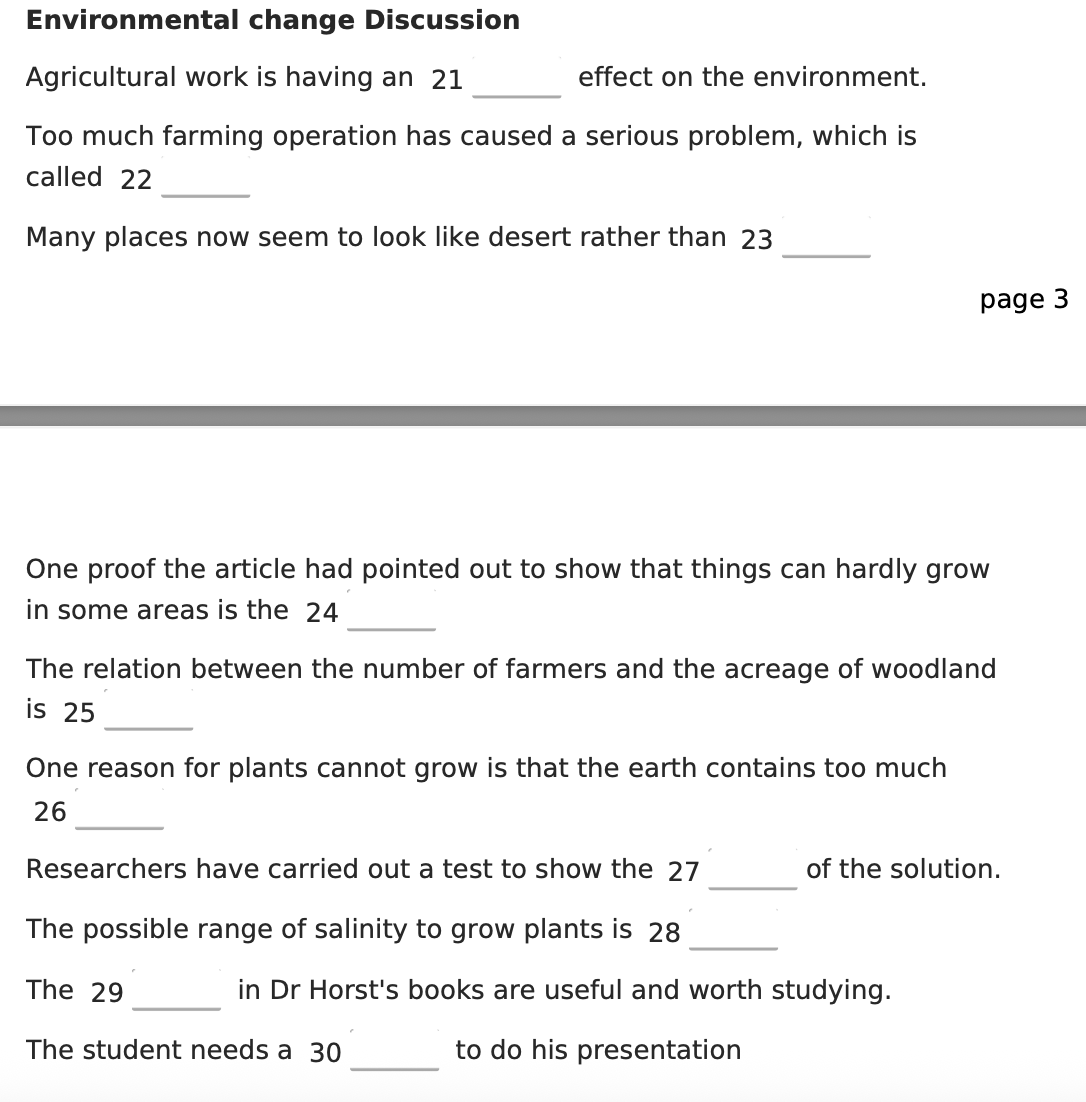
[01:30.42]PETE:Agriculture is having a really adverse impact on the environment.
[01:33.90]There are too many farmers doing too much farming.
[01:36.86]It’s really destroying the forests and ruining the soil.
[01:39.94]Deforestation is a major problem there now.
[01:42.22]DAVE:How did you learn about this?
[01:44.45]I don’t recall Dr Schnee saying anything about it in lecture.
[01:48.85]PETE:Yes, but my brother went there last month, you know, to look at the old cities the Maya Indians built.
[01:55.01]That’s what first got me interested.
[01:56.85]DAVE:Your brother Tom?
[01:58.45]PETE:No, Dick, Harry’s twin.
[02:00.29]Anyway, he told me how few trees there were now and how much empty ground that grows almost nothing.
[02:06.89]PETE:He said the place looked more like the desert than jungle in some parts.
[02:10.97]It brought environmental damage.
[02:12.97]PETE:So I started looking for materials in the library.
[02:15.61] Here, look at this magazine.
[02:17.17]DAVE:What’s in it?
[02:18.17]PETE:It's an old issue of “National Geographic”.
[02:20.85]PETE:It includes interviews with tourists who’ve been there in the past few years.
[02:25.17]It’s pretty bad.
[02:26.29]See the photos?
[02:27.29]DAVE:I see the photos, but one or two photos don’t prove anything.
[02:31.61]PETE:Then read what the article says.
[02:33.37]Right there.
[02:34.25]The first thing it points out is how soil samples show it is hard for anything to grow there.
[02:39.33]PETE:_###It says how an area of 21,000 square kilometres has lost most of its forest in the past ten years.
[02:45.89]PETE:_###See, there are graphs.
[02:47.93]As the number of farmers increases, the acres of forest have decreased.
[02:52.01]It’s an inverse relation.
[03:34.86]DAVE:So how big is that state?
[03:37.26]I’m sorry, but I’ve never really learned the metric system.
[03:40.82]PETE:It’s bigger than the state of Massachusetts!
[03:42.98]DAVE:That’s shocking!
[03:44.70]Anything else?
[03:45.74]PETE:There’s lots of else.
[03:47.26]Scientists say there’s a “growing area” of about 10.5 square kilometres where nothing can grow at all.
[03:53.74]It’s like the beginning of a desert.
[03:55.58]DAVE:Oh yes.
[03:56.62]What Dr Schnee called “desertification”.
[04:00.25]DAVE:But, why can’t anything grow there?
[04:02.69]I’ve never really studied soil chemistry.
[04:05.17]PETE:I’m just starting to look into that subject, but my sister Marie is a geologist and she says the problem is that the soil has too much saline, with no plants helping to adjust the chemistry.
[04:15.09]PETE:Apparently, that’s a common problem with soil types throughout areas with rainforest.
[04:19.37]Once you lose the plant cover, it’s difficult to bring it back.
[04:22.85]PETE:Reforestation is almost impossible, even if the land is not being used for other purposes.
[04:27.47]DAVE:Wait a minute.
[04:28.39] What is “saline”?
[04:30.39]PETE:Saline is salt dissolved in water.
[04:32.67]PETE:Scientists who’ve gone there have taken measurements.
[04:35.31]They do this by gathering a sample of the soil and running a simple test that shows the ionisation of the solution.
[04:41.87]PETE:The Geology Department in our own university has reviewed the soil at the site, too.
[04:46.83]They’re right.
[04:47.71]PETE:It looks pretty bad.
[04:48.87]The level of salinity is going up.
[04:51.03]PETE:But the plants that would solve that problem can’t be planted in soil like that.
[04:55.19]PETE:There is a narrow spectrum of salinity in which the plants will grow.
[04:59.07]DAVE:And once you pass the threshold, there is no way to put the problem right?
[05:04.27]PETE:Exactly.
[05:05.15]It’s possible that no one can do anything to stop the trend now.
[05:09.23]All because of human greed!
[05:10.91]I...
[05:11.15]DAVE:Wait a second.
[05:12.35]How do you know these “scientists” can be trusted?
[05:15.75]What kind of reputation do they have?
[05:18.58]Are they reliable?
[05:19.98]PETE:Oh they're definitely reliable.
[05:21.90]They include four members of the faculty from the Geology Department right here at MIT.
[05:27.02]PETE:Here, study these photographs and check the damage yourself.
[05:30.78]PETE:That’s what Dr Horst who wrote this book here did.
[05:33.90]He’s newly appointed, but Dr Schnee says he’s brilliant.
[05:37.70]DAVE:So, where are you going now?
[05:39.82]PETE:I’m headed over to the Geography Department to borrow a map for my presentation.
[05:43.81]PETE:You know, this whole problem could have been avoided!
[05:46.01]The farmers there in the Yucatan
[05:48.37]DAVE:Uh, Pete??
[05:48.97]PETE:Yeah?
[05:49.53]DAVE:Go take a break!
[05:50.85]Leave some studying for the rest of us.