[00:53.69]Ladies and gentlemen, welcome to Auckland zoo on this sunny Sunday afternoon and to our special kiwi fundraising event.
[01:03.45]My job is to tell you all about the amazing little kiwi and your job hopefully is to dig deep in your pockets.
[01:12.52]Now for the benefit of our overseas visitors here today, I should explain, first of all, that the kiwi is the national bird of New Zealand, and sometimes New Zealanders themselves are known as Kiwis.
[01:27.20]Now, while Kiwis in the wild are a rare sight, the kiwi as a symbol is far more visible.
[01:35.12]Apart from being in toy stores and airport shops all over the world, you'll find them on our stamps and coins.
[01:43.47]The kiwi is the smallest member of the genus, apteryx which also includes ostriches and emu.
[01:51.99]It gets its name from its shrill call, which sounds very much like this.
[02:01.48]Kiwi live in forests or swamps and feed on insects, worms, snails, and berries.
[02:09.52]It's a nocturnal bird with limited sight, and therefore, it has to rely on its very keen sense of smell to find food and to sense danger.
[02:20.80]Its nostrils are actually right on the end of its long beak, which is 1/3 of the body length.
[02:28.20]Now here's an interesting fact.
[02:30.88]Although Kiwis have wings, they serve little purpose because the kiwi is a flightless bird.
[02:39.44]Since white settlement of the islands, kiwi numbers have dropped from 12 million to less than 70,000.
[02:47.80]Our national bird is rapidly becoming an endangered species.
[02:52.36]This is because they're being threatened by what we call introduced animals, animals which were brought to New Zealand, such as cats and ferrets, which eat kiwi eggs and their chicks.
[03:52.63]We have launched the kiwi recovery program and an all out effort to save our national bird from extinction.
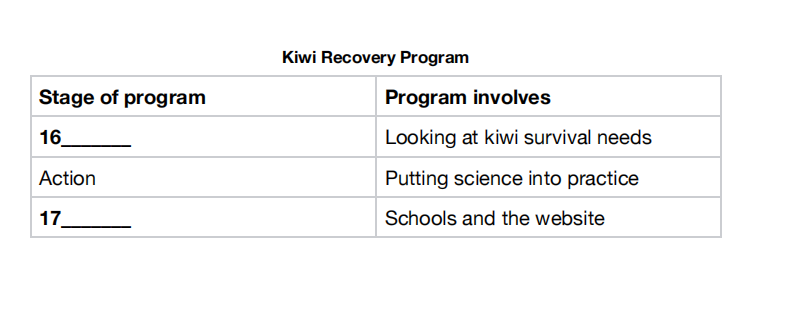
[04:00.19]There are three stages to this program.
[04:02.75]Firstly, we have the scientific research stage.
[04:06.91]This involves research to find out more about what Kiwis need to survive in the wild.
[04:13.49]Then, secondly, we have the action stage.
[04:17.25]This is where we go into the field and actually put our knowledge to work.
[04:21.97]We call this putting science into practice.
[04:26.49]And then we come to the third stage, the global education stage by working with schools and groups like yourself as well as through our award winning kiwi website.
[04:39.94]We are hoping to educate people about the plight of the kiwi as part of the action stage which I just mentioned.
[04:50.18]We've introduced operation, nest, egg, and this is where your money will be going.
[04:55.78]It works like this.
[04:57.66]It's a three stage process.
[05:00.42]First of all, we go out to the Kiwis natural habitat and we collect kiwi eggs.
[05:07.39]This is the tricky part because it can be very difficult to find the eggs then and safe surroundings away from predators.
[05:16.67]The chicks are reared.
[05:19.39]Now, this can be done on predatorFree islands or in captivity.
[05:25.80]They're reared until they're about 9 months old at which stage the chicks are returned to the wild.
[05:33.60]So far, it's proving successful.
[05:36.80]Since we started the program, some 34 chicks have been successfully raised this year.
[05:43.24]And their chances of survival have increased from 5 to 85 %.
[05:49.78]However, it's not time to celebrate kiwi survival just yet.
[05:55.34]About 95 % of kiwi chicks still don't make it to 6 months of age without protection, which is why operation nest egg is so important.
[06:07.22]And we ask you to give generously today.