显示生词 Tip: 色块区域是你划选过的生词,查询次数越多,颜色越深哦~ 显示重点词 Tip: 加粗单词为本章重点词哦!
Few murder enquiries have stirred the public imagination to such an extent as those relating to Jack the Ripper. The report of murders worthy of a depraved savage simultaneously appalled and enthralled Victorian society as the 19th century came to a close. The unleashing of a serial killer onto the London scene caught police unprepared as did the unprecedented brutality of the killings which earned their perpetrator the nickname 'Jack the Ripper'. So, given the heightened public interest and the existence of a police force more competent than ever before since the formation of the Metropolitan Police in 1829, it has to be asked: why did the Ripper evade capture and why was no one even charged with the five murders attributed to the Ripper?
Conspiracy theorist would have us believe that the identity of the Ripper was, contrary to public belief, unmasked by police. However, the truth about the Ripper's identity proved so unpalatable that it had to be hushed up. Far-fetched as it may seem, Queen Victoria's grandson, Prince Albert Victor, was thought by some to be the Ripper himself. Whilst he did frequent places of ill repute, there is no tangible evidence to support this somewhat sensationalist theory. In fact, the Ripper may have successfully evaded the police for far more prosaic reasons.
Back in 1888, when the Ripper began his reign of terror in the streets of Whitechapel, forensic science was barely in its infancy. Rudimentary knowledge existed as to the necessity of keeping a murder scene intact to preserve vital clues but the means to thoroughly analyse such evidence through DNA testing was light years away still. In fact it was only with the publication of Hans Gross' 'A Handbook for Examining Magistrates, Police Officials, Military Police, etc.' in 1893 that the foundation for forensic science was laid. It was too late, however, to help the Ripper investigation that floundered in its ignorance of modern forensic techniques.
The Ripper investigation also just missed out on developments in fingerprint identification that might have led police to the identity of the Ripper. Nearly a decade prior to the first Ripper murder, Dr. Henry Faulds had published a letter in the scientific journal Nature in 1880. In the letter he outlined for the first time the possibility of using fingerprints for identification purposes. It was only in 1896 that Sir Francis Galton, Inspector General of Bengal Police, sought to put theory into practice. Using the new-found method of 'dactyloscopy' (later known as fingerprinting) he employed the technique to successfully identify criminals. Again, new technology arrived just too late for the Ripper investigators.
Whilst investigative police could not be blamed for a lack of forensic knowledge, their failure to apply known investigative methods to the crime scene certainly smacked of incompetence. Photographing the crime scene was not exactly standard practice of the time but it was a known procedure. Unfortunately the officers leading the investigation at the time saw fit to only photograph one of the Ripper's victims, a certain Mary Kelly, at the crime scene. Even more bizarrely, photographs of the victim were more centred on photographing her eyes to the neglect of all else. The reason or 'forlorn hope' as cited by Inspector Walter Dew was that the imprint of the Ripper might have been recorded on the victim's retina at the time of her death. No conclusions were drawn from the undertaking.
Another more serious criticism that has been levelled at the investigative police at the time is their deliberate tampering with evidence. It is well-known that a semi-illiterate message was scrawled above one of the Ripper's victims. However, before it could be properly analysed, the investigating officer ordered that it be removed as it was thought to implicate the Jews and racial repercussions were feared. The motive was well-intended but this action may have destroyed vital clues.

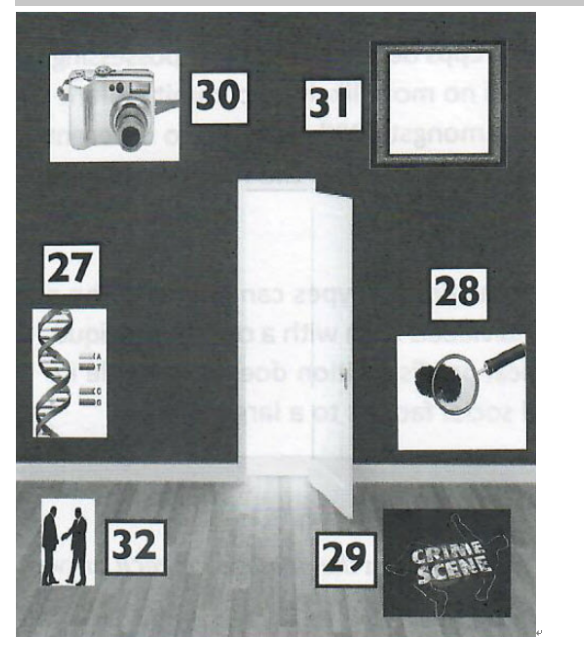
Complete the notes below.
Write NO MORE THAN THREE WORDS from the passage for each answer.


