显示生词 Tip: 色块区域是你划选过的生词,查询次数越多,颜色越深哦~ 显示重点词 Tip: 加粗单词为本章重点词哦!
What is today a simple children's toy has a surprisingly rich history. Dolls have been a part of humankind for thousands of years. Often depicting religious figures, or used as playthings, early dolls were probably made from primitive materials such as clay, fur, or wood. Dolls through the ages.
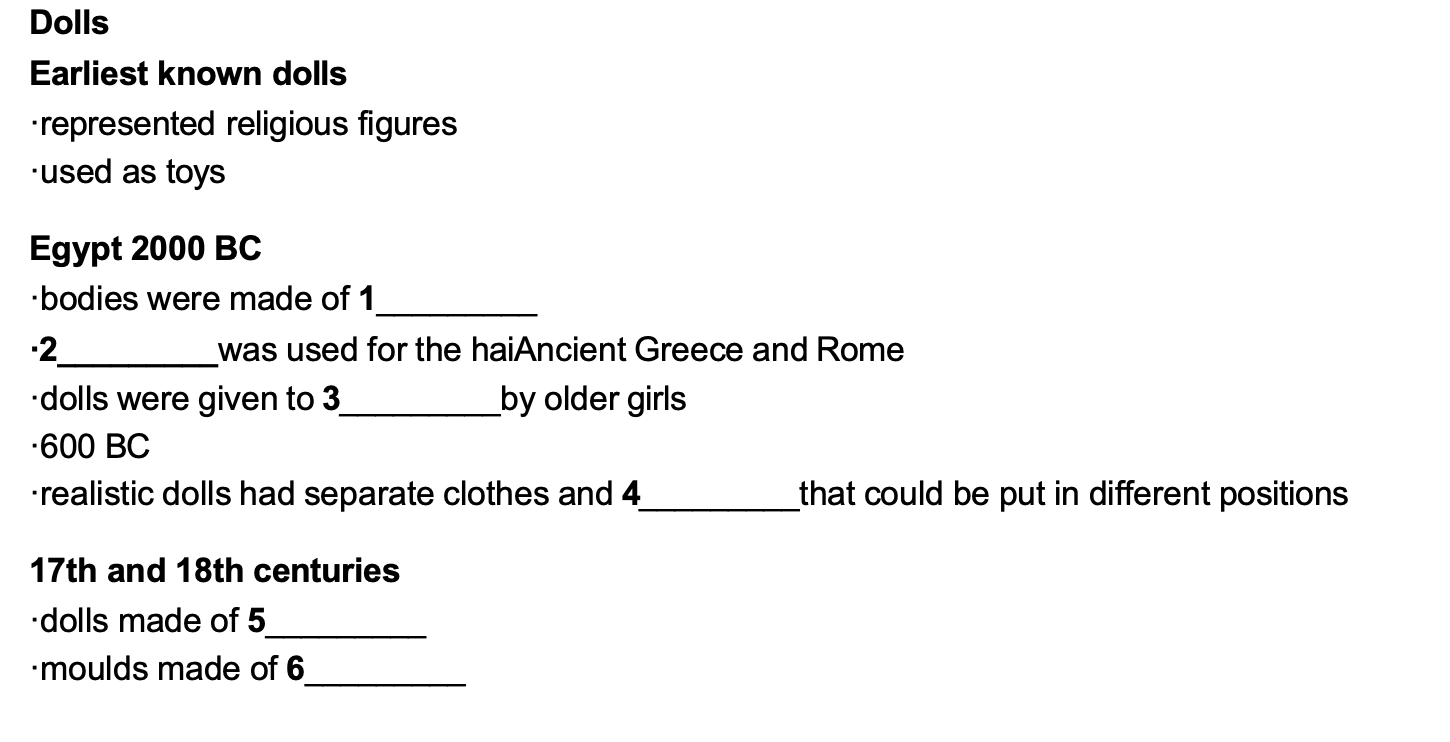
Dolls constructed of flat pieces of wood, painted with various designs, and with hair made of clay, have often been found in Egyptian graves dating back to 2000 BC. Egyptian tombs of wealthy families have included pottery dolls. Dolls being placed in these graves leads some to believe that they were cherished possessions.
Girls from ancient Greece and Rome offered their wooden dolls to goddesses after they were too 'grown-up' to play with dolls. Most ancient dolls that were found in tombs were very simple creations, often made from such materials as clay, rags, wood, or bone. Some of the more unique dolls were made with ivory or wax. The main goal was to make the doll as lifelike as possible. That ideal led to the creation of dolls with movable limbs and removable garments, dating back to 600 BC.
Following the era of the ancient dolls, Europe became a major hub for doll production. These dolls were primarily made of wood. Fewer than 30 examples of primitive wooden stump dolls from England survive today. The Grodnertal area of Germany produced many peg wooden dolls, a type of doll that has very simple peg joints and resembles a clothespin (a device for hanging washing on a clothesline). An alternative to wood was developed in the 1800s.
'Composition' is a collective term for mixtures of pulped wood or paper that were used to make doll heads and bodies. These mixtures were moulded under pressure, creating a durable doll that could be mass produced. Manufacturers closely guarded the recipes for their mixtures, sometimes using strange ingredients like ash or eggshells. Papier-mâché, a type of composition, was one of the most popular mixtures.
In addition to wooden dolls, wax dolls grew in popularity in the 17th and 18th centuries. Much in Germany was a major manufacturing center for wax dolls. Wax dollmakers would model a doll's head in wax or clay, and then cover it with plaster to create a mould. Then they would pour melted wax into the cast. The wax for the head would be very thin, no more than 3 mm. Some of the most distinctive wax dolls were created in England between 1850 and 1930. One of the first dolls that portrayed a baby was made in England from wax at the basinsion of the 10th century.
Around the same time porcelain became popular. It is made by firing special clays in a kiln at more than 2372 degrees Fahrenheit (1300°C), and only a few clays can withstand firing at such high temperatures. Porcelain is used generically to refer to both china and bisque dolls; china is glazed, whereas bisque is unglazed. Germany, France, and Denmark started creating china heads for dolls in the 1840s. These china heads were replaced in the 1860s by ones made of bisque. Bisque, which is porcelain fired twice with colour added to it after the first firing, looked more like skin than china did.
In France, the bébé was popular in the 1880s, and it has become a highly sought after doll today. The bébé, first made in the 1850s, was different from its predecessors because it depicted a younger girl. Until then, most French dolls were representations of adults. Although the French dolls were unrivalled in their artistry, German bisque dolls became quite popular because they were not as expensive. Kammer & Reinhardt introduced a bisque character doll in the 1900s, starting a trend of creating realistic dolls.
For many centuries, rag dolls were made by mothers for their children. The term 'rag doll' refers generically to dolls made of any fabric. 'Cloth doll' refers to a subset of rag dolls made of linen or cotton. Commercially produced rag dolls were first introduced in the 1850s by English and American manufacturers. Although not as sophisticated as dolls made from other materials, rag dolls were well loved, often as a child's first toy.
Dollmaking did not become an industry in the United States until after the Civil War in the 1860s. Doll production was concentrated in the New England region of the United States, with dolls made from a variety of materials such as leather, rubber, papier-mâché, and cloth. Celluloid was developed in the state of New Jersey in the late 1860s and was used to manufacture dolls until the mid-1950s. German, French, American, and Japanese factories churned out cheaply produced celluloid dolls in mass quantities. However, celluloid fell out of favour because of its extreme flammability and propensity to fade in bright light.

Do the following statements agree with the text? Write
TRUE - if it agrees;
FALSE - if it contradicts;
NOT GIVEN - if there's no info
7.Bisque dolls appear less realistic than dolls made of china.
8.French dolls tended to cost more than German bisque dolls.
9.The first rag dolls were made in the 1850s.
10.Only dolls made of cotton or linen are classified as cloth dolls.
11.Dolls made of celluloid tended to lose their colour.
12.Composition dolls lasted longer than the plastic dolls that were made in the 1940s.
13.Doll collectors prefer a doll to be dressed in its original clothing.