[00:24.19]A talk given by a lecturer to a group of civil engineering students on the reed bed system for sewage treatment
[01:08.59]L: Thank you for inviting me to speak to you today about what is now called the reed bed sewage treatment system. This system uses naturally occurring reeds to treat domestic and industrial waste.
[01:22.20] It's an environmentally friendly alternative to normal systems.
[01:27.13]L: You all know what reeds are like, don't you? - those tall plants with hollow stems that grow in wet places ... like marshes, for example.
[01:36.00]Here's how the system works.
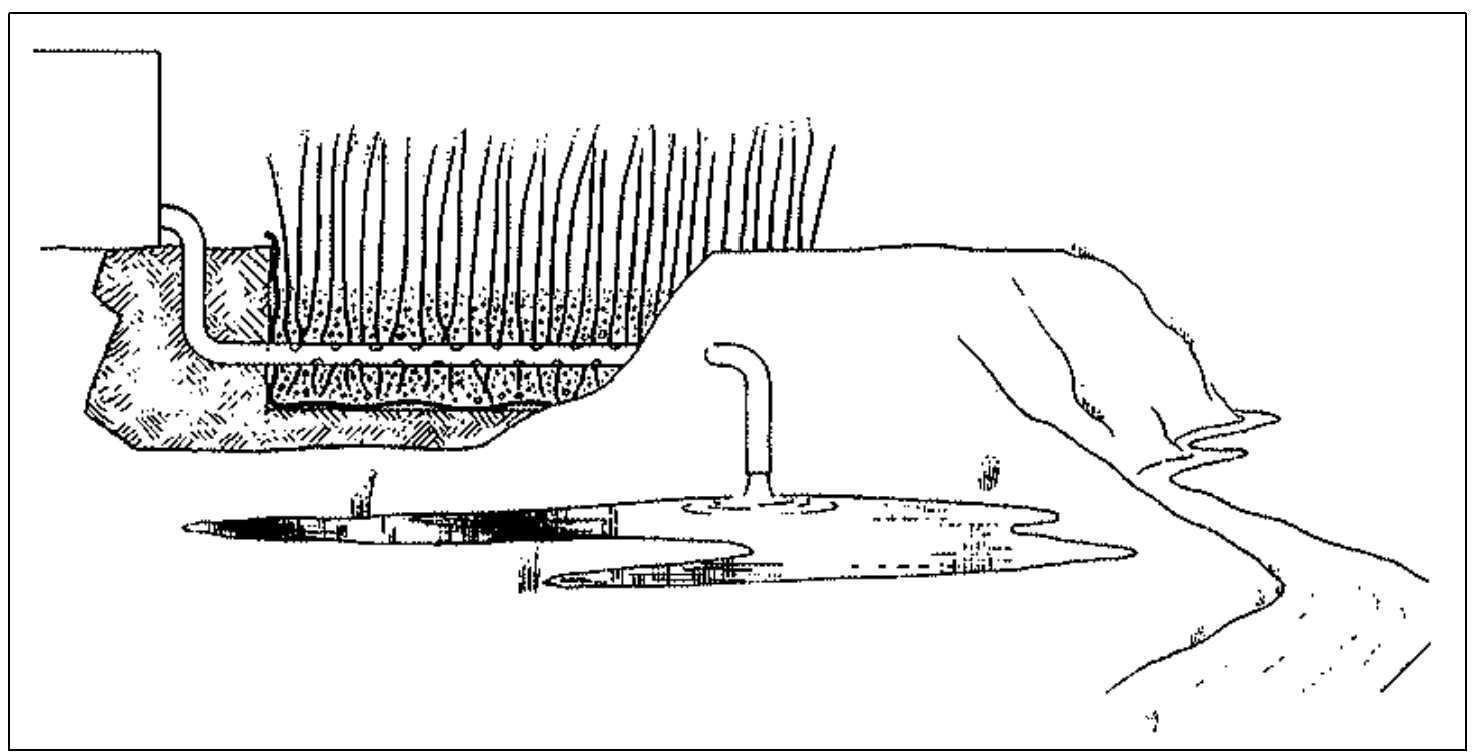
[01:38.56]L: First of all, an artificial marsh is created. To do this, holes are dug about 1 metre deep and usually rectangular in shape. They are then lined with clay or plastic and the liner is covered with gravel.
[01:53.74]L: After that, a system of tubing is laid, with holes in it and more gravel is added to cover that. Finally, reeds are planted in the bed.
[02:03.21]L: The sewage is brought to settling tanks. From there it is distributed to the roots of the reeds through the tubing.
[02:11.29]L: Note that the waste material enters the beds underground and remains underground. The reeds conduct oxygen very efficiently through their stems to the roots system.
[02:22.91]L: Here, bacteria work to reduce the waste material to basic elements. What comes out of the artificial marsh is water that has been cleaned through a natural process.
[02:34.76]L: The purified water leaves the reed bed through a simple outflow pipe. The water that comes out has to be tested.
[02:44.86]L: Sometimes it is held in a pond until it evaporates or soaks into the ground. Sometimes, after testing, the water is discharged directly into streams and rivers.
[03:33.81]L: The reed bed system originated in Germany in the 1970s and installations have been built in a number of countries throughout the world.
[03:43.25]L: To give you an idea of the size and appearance of a reed bed installation, an area of 3 by 5 metres approximately would be adequate for a single house. It would look like a pond overgrown with reeds.
[03:57.46]L: There are cities with 150,000 people in Germany whose entire sewage treatment requirements are served by reed bed installations which extend for 10 - 20 hectares.
[04:10.90]L: There are two wonderful environmental advantages.
[04:14.63]First of all, reed bed systems are natural composters. As time passes high grade soil builds up in the beds.The soil can be removed and used for agricultural purposes. Soil produced from waste containing heavy metals would, of course, have to be tested and the toxic material removed by chemical processes.
[04:39.27]L: An additional advantage is that the reed bed can function exactly as a marsh, providing a healthy natural home or habitat for waterfowl and other birds, insects, reptiles and mammals.
[04:53.57]L: But there are practical advantages to a reed bed system over existing sewage treatment plants as well.
[04:59.77]L: At all levels the cost is lower than for normal systems. Labour costs are a fraction of the costs of a conventional system. Typically, a large-scale reed bed installation will cost 10% less than a mechanical system.
[05:16.17]L: They require little maintenance and unlike mechanical systems, the efficiency of reed beds increases over time.
[05:24.89]L: But before we go any further, you must have some questions? Maybe this sounds too good to be true.
[05:30.81]S1: That's exactly what I wanted to ask. If these systems have so many benefits, why aren't they more popular? Why don't we see them everywhere?
[05:40.83]L: As I said, the technology is now almost 40 years old, Demonstration projects of all types have been built and monitored and are slowly convincing regulators of the advantages of the system.
[05:52.49]L: But you have to understand that regulating authorities are by nature conservative and resist change. Typically, there is a lot of opposition to these systems - by manufacturers, and by everyone involved in maintaining the conventional systems.
[06:06.49]Reed bed systems require fewer staff to operate so there would be a decline in the workforce. Therefore, unions would resist the change as well.
[06:15.48]S2: What happens to reed beds in winter? Does the efficiency decrease?
[06:20.96]L: The above ground part of the plants die back in cold weather but the roots remain alive and active and the system continues to work just as effectively in winter. As soon as the weather warms up, new reeds appear and grow in quickly.
[06:34.60]S3: Is there a problem with mosquitoes in these ponds?
[06:38.46]L: Well, they are not exactly ponds, with standing water. The beds look more like a field, covered with long grass.
[06:45.06]The soil is moist but not like a swamp so there would be no more mosquitoes than in any other field.
[06:51.50]Remember, the effluent enters the beds underground and remains underground.
[06:57.41]L: OK. Let's get into some of the technical details now and I'll answer questions as they come up.