[00:58.94]Good afternoon, ladies and gentlemen.
[01:00.58]I’d like to take this opportunity to welcome you to our exhibition, “Two Centuries of the Bike”.
[01:06.38]Let’s stroll around the exhibition, shall we?
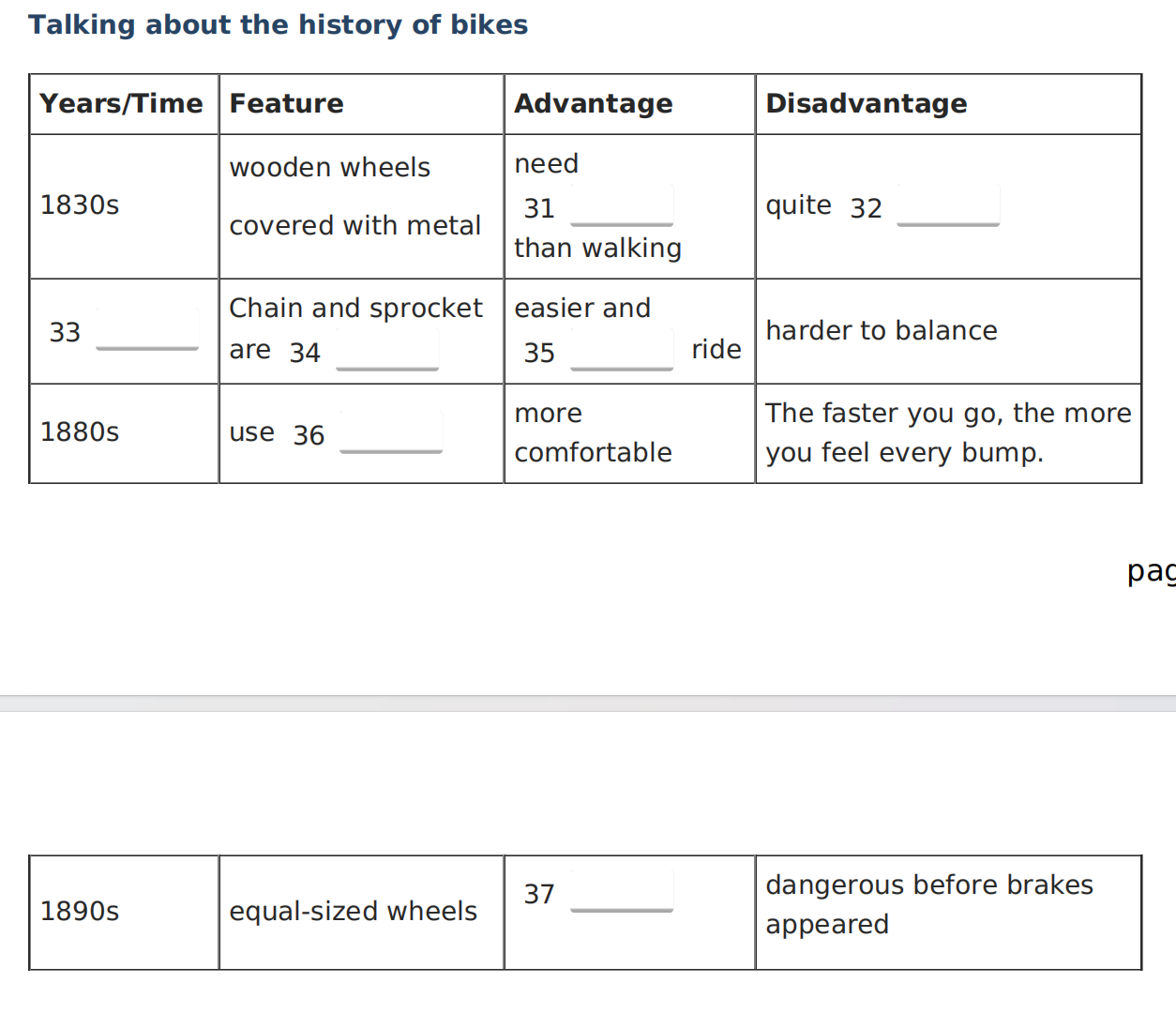
[01:09.21]Although there were a few early efforts back in the 1700s, you didn’t really see many bikes till, say, the 1830s in England.
[01:17.61]Bikes were a response to the rapid growth of cities early in the 19th century.
[01:20.09]Cities like London were getting too big to walk across!
[01:26.49]The early bike let people travel with less effort than walking. Plus a bike was a lot cheaper than a horse!
[01:33.09]Think of it. No one invented a bike for, what, five thousand years of human history?
[01:39.01]Why did people do it then? Probably because this was the start of the Machine Age: people wanted machines to do all the work.
[01:47.51]There were some drawbacks, however.
[01:49.71]For one thing, there were no pedals. You simply pushed yourself along using your feet.
[01:54.27]Kind of like today’s skateboard. That meant you went fairly slowly.
[01:58.51]And uphill, you actually worked harder, pushing that two-wheeler.
[02:02.83]Plus, the wheels were made of wood covered with metal, as you can see from this model.
[02:08.03]So the downside was that the ride was quite uncomfortable on most roads.
[02:12.74]Only a few gadget lovers had or used them.
[02:15.46]By the 1860s, though, improvements were being made.
[02:18.98]As you can see from this specimen, metal frames had become the rule.
[02:22.86]They’re more durable than wood, and they don’t warp in the rain.
[02:26.62]The biggest improvement however was the development of the chain and sprocket system.
[02:30.62]They are connected.
[02:32.16]This meant you did not push the bike. You used pedals just like today.
[02:36.91]You had to try harder to balance, so it took some practice to figure out how to use the pedals.
[02:42.59]But it made the ride so much easier.
[02:45.11]As a result, the good thing was that you could ride a lot faster and with very little effort.
[02:50.83]By the 1880s, another big change was the use of rubber wheels.
[02:55.31]These became pretty common at that time.
[02:57.71]Though the first ones were solid rubber, the ride was a good deal more comfortable than the old iron and wood system.
[03:04.23]This is a big consideration because the faster you go, the more you feel every bump.
[03:09.71]Air-filled tyres - “pneumatic tyres” - didn’t really come into use till around the year 1900, as you can see from this exhibition over here. That made the ride even more comfortable.
[03:21.70]So, by 1890 or so, people were going a lot faster and a lot more smoothly.
[03:26.26]There was one problem when you were going quickly and comfortably: “OH NO! HOW DO I STOP?"
[03:31.54]Yes, we all laugh now.
[03:33.14]But for a long time, the only way to stop was drag your feet.
[03:36.98]That didn't work very well and it would be dangerous if you were going fast.
[03:41.33]In the crowded cities of those years - New York, Chicago, and so on, you would get killed if you couldn't stop for, say, a streetcar.
[03:49.33]Plus look at this bike.
[03:50.81]The front wheel is nearly a metre and two thirds tall!
[03:53.97]They made them that way so you could see over people and wagons.
[03:57.89]But you couldn’t drag your feet.
[03:59.92]This model is called a “velocipede” - a “speed pedal”.
[04:03.80]Another characteristic of the bike in this period is that it has two equal-sized wheels, which signalled a big change in bikes.
[04:11.48]For with the velocipede, brakes appeared.
[04:13.80]If you wanted to stop, you just pushed the pedal backwards.
[04:17.08]Doing that stopped the back wheel of the bike.
[04:19.84]This technique worked a lot better than dragging your feet or jumping off the high seat there!
[04:24.48]This meant that bikes became a great deal safer. It would have been safer if people wore helmets, but the first bicycle helmet wasn’t invented until years later, and even then it was little more than a leather ballcap.
[04:36.92]It really wasn’t until the 1970s that the bike helmet was modified to provide some real protection.
[04:47.01]Before continuing on to look at developments since the 1890s, let’s say a word more about safety.
[04:52.89]Everyone knows if you’re going downhill, you can get going dangerously fast.
[04:57.21]To go more than a hundred kilometres an hour isn’t all that difficult!
[05:00.89]But even on level ground it’s easy to go too quickly.
[05:04.45]On a city street, today’s bicycles can be ridden at a speed of over forty miles an hour, over a short distance.
[05:11.01]That's about sixty-four kilometres an hour.
[05:13.89]Remember you’re on a bike, not in a car.
[05:16.73]There’s nothing to protect you.
[05:18.37]People are killed in single-bicycle accidents every day, just from hitting the road.
[05:23.25]A good rule to remember is, if you're going faster than the cars, slow down.
[05:28.25]And please wear a helmet. Nearly one quarter of the epilepsy cases come from head injuries in accidents on bikes and motorcycles.
[05:36.95]I didn’t mean to scare you, but safety is everyone’s business.
[05:40.79]What? Now that’s a good question.
[05:43.55]Why are today’s bikes so much faster?
[05:45.99]Well, it’s not just that today’s athletes are faster.
[05:49.03]The answer is partly mechanical.
[05:51.51]If you look closely here, at the back wheel you’ll see a number of gears.
[05:55.47]Changing gears is what makes those fast speeds possible.
[05:59.43]You can shift gears depending on the terrain and how hard you wish to pedal.
[06:03.67]You can put it on a higher gear for downhill, and a lower gear for uphill travel to make it easier to climb that slope.
[06:10.50]You’ll notice this gearshifting mechanism is attached at the back wheel, and when the rider shifts on the handlebar gear shifter, the chain moves to the appropriate sprocket.
[06:20.46]And, speaking of changing gears, let’s look over here at our “Tour de France” exhibit...