[01:47.90]Good morning, everyone.
[01:50.49]Today, I'll be discussing the role of technology in modern farming, particularly in the UK, where technological advancements are helping farmers address various challenges.
[02:01.87]To begin with, one of the biggest challenges UK farmers face is financial instability.
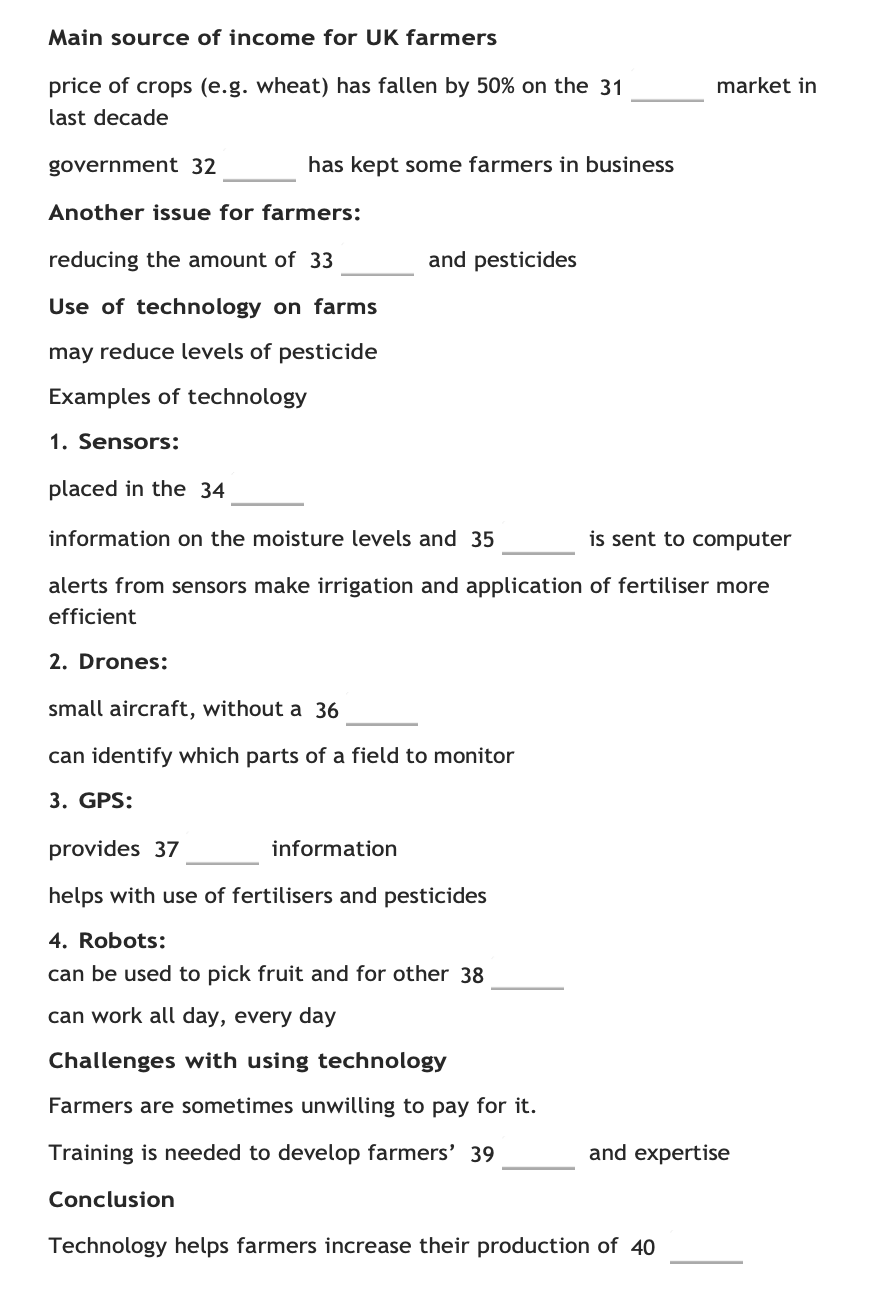
[02:08.39]Over the past decade, the price of key crops such as wheat has fallen dramatically.
[02:13.43]On the international market, for instance, the price has dropped by as much as 50%, making it difficult for farmers to maintain profitability.
[02:23.52]While some have been able to adapt by diversifying their crops or seeking alternative revenue streams, many have relied on government subsidies to stay in business.
[02:35.38]These financial supports help offset losses and sustain the agricultural sector.
[02:41.62]Another major issue for farmers is the need to reduce their dependence on chemical inputs such as fertiliser and pesticides.
[02:49.90]Excessive use of these substances not only affects soil quality but also poses risks to the environment and human health.
[02:59.13]Technology is increasingly being used to address this concern, offering solutions that optimise resource use and minimise waste.
[03:08.21]Now, let's look at some of the specific technologies being used on farms today.
[03:13.21]One such innovation is the use of sensors.
[03:16.49]These small but powerful devices are placed in the soil to monitor conditions in real time.
[03:23.10]They provide crucial data on moisture levels and temperature, which is then sent to a computer system.
[03:30.43]This allows farmers to make informed decisions regarding irrigation and fertiliser application, ensuring resources are used efficiently and effectively.
[03:41.41]Another important tool is drones.
[03:44.01]These small aircraft, which operate without a pilot, are used to survey fields from above.
[03:50.53]Equipped with cameras and other sensors, drones help identify specific areas that require attention, such as sections affected by disease or inadequate irrigation.
[04:03.41]This targeted approach reduces waste and increases overall efficiency.
[04:09.17]A third technology that has transformed modern farming is GPS.
[04:14.87]This system provides accurate location information, helping farmers apply fertilisers and pesticides more precisely.
[04:22.83]Instead of treating entire fields uniformly, GPS enables site-specific management, reducing costs and minimising environmental impact.
[04:32.65]Furthermore, advancements in robot technology are also making an impact.
[04:38.19]Robots are now being used for a variety of tasks, such as harvesting fruit, planting crops, and even removing weeds.
[04:46.93]Unlike human workers, these machines can operate continuously without the need for breaks, making them an attractive option for farms facing labour shortages.
[04:58.61]Despite the clear advantages, adopting these technologies does come with challenges.
[05:04.62]One of the main barriers is cost---some farmers are hesitant to invest in expensive new technologies, particularly when their profit margins are already tight.
[05:16.05]Additionally, implementing these systems requires training.
[05:20.97]Farmers need to develop new skills and expertise to operate and maintain the equipment effectively.
[05:27.61]In conclusion, the use of technology in agriculture is becoming increasingly essential.
[05:33.93]It allows farmers to maximise productivity while minimising resource waste.
[05:39.43]As a result, technology plays a crucial role in increasing the production of food, ensuring that farms remain sustainable and profitable in the long term.
[05:50.65]Looking ahead, researchers are continuously developing new agricultural technologies to further improve efficiency and sustainability.
[06:01.22]Innovations such as precision farming, artificial intelligence, and automated machinery could soon become standard on farms worldwide.
[06:11.50]However, successful implementation will require ongoing investment, education, and adaptation by farmers.