[00:41.11]Interviewer:Hello everyone.
[00:42.27]I've just been joined in the studio by Dr. Matthew Johnson.
[00:45.71]Dr. Johnson works at Westley General hospital and he is here today to tell us all about giving blood.
[00:51.31]Good morning Matthew.
[00:52.59]Matthew:Good morning.
[00:53.83]Interviewer:So, Matthew.
[00:54.75]Why is it important for us to give blood?
[00:57.54]Matthew:Donating blood is not important.
[00:59.38]It's actually vital that people do this.
[01:02.72]Without donated blood, thousands of people would die every year and it's something that could affect everyone.
[01:08.80]We all expect blood to be there for us, but barely a fraction of those who can give, do.
[01:14.24]Yet sooner or later, virtually all of us will face a time of great vulnerability in which we will need blood.
[01:21.08]And that time is all too often unexpected.
[01:24.08]The need for blood is great.
[01:26.00]On any given day, an average of 38 thousand units of red blood cells are needed.
[01:31.28]Blood transfusions are often needed for victims of things such as accidents and burns, heart surgery, organ transplants, and patients receiving treatment for leukaemia, cancer or other diseases.
[01:43.05]In 2002, nearly 29 million units of blood components were transfused.
[01:48.34]And with an aging population and advances in medical treatments and procedures requiring blood transfusions, the demand for blood continues to increase.
[01:56.50]Interviewer:Do we really need that much?
[01:58.06]Matthew:Yes.
[01:58.66]And we need it now.
[02:00.30]Blood supplies nationwide have reached critically low levels, with less than one day's supply of several blood types.
[02:06.85]Matthew:Thousands of accident victims, cancer patients, premature babies and countless others who need blood to stay alive are hoping you'll care enough to help them.
[02:16.01]All blood types are needed.
[02:50.84]Interviewer:What are the different types?
[02:52.76]Matthew:It's a bit more complicated than that.
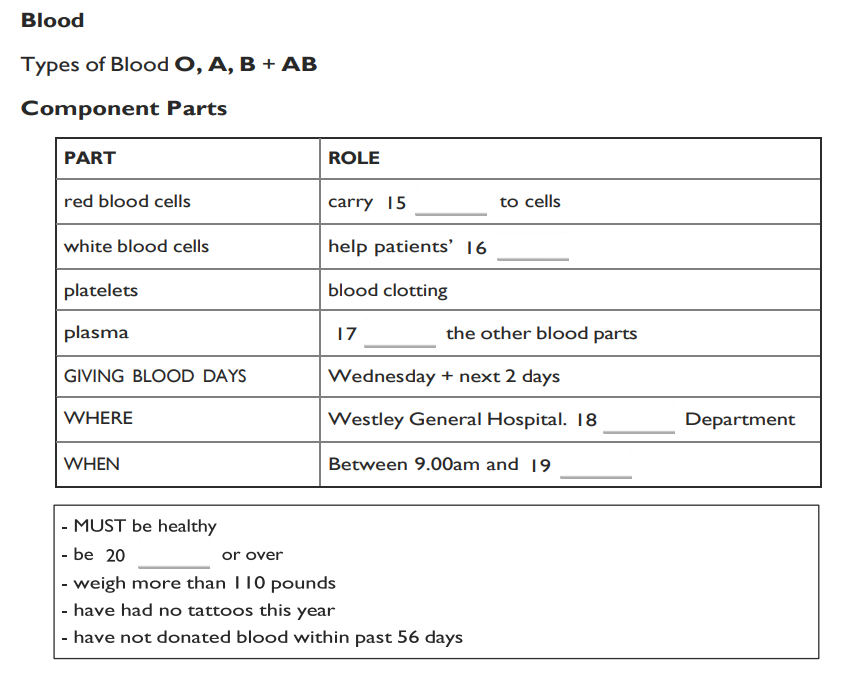
[02:55.12]First we collect the whole blood from donors and then it's sorted into the different types which are basically O, A, B or AB though there are also divisions here.
[03:06.14]Then the blood is split into its constituent parts.
[03:09.34]We divide it into 4 basic parts.
[03:12.02]First there are the red blood cells, then the white blood cells, then things called platelets and finally plasma.
[03:19.88]This is shipped off to hospitals where they use the blood parts that the patients need.
[03:24.08]Interviewer:What are the different parts used for?
[03:26.36]Matthew:Well, as I said before the whole blood is your blood in its natural state and something we rarely use.
[03:32.68]It's much more useful to us to have it separated into its component parts.
[03:37.59]Red blood cells are what everyone associates with blood, i.e.: it's red.
[03:41.99]It's widely used to replace lost blood during surgery or when people hemorrhage.
[03:47.25]Its main function is to carry oxygen to cells.
[03:50.96]Matthew:White blood cells are the most important part of the body's immune system and they're used for patients whose normal defense systems aren't working properly.
[03:59.84]Platelets are crucial for making your blood clot and we need to give them to patients who suffer from illnesses that deplete their natural levels of platelets or they will bleed to death.
[04:10.94]Finally, plasma is what carries the other parts of blood around and needs to be administered with any of the other components.
[04:18.50]Take away the red blood cells and this is actually yellow.
[04:22.14]Interviewer:So, that's what blood is all about.
[04:24.62]Now, you're here in Westley today to collect blood.
[04:27.50]Can you tell us where and when we can donate?
[04:30.02]Matthew:Of course!
[04:31.10]We're set up here today, that's Wednesday, and for the next two days at Westley General Hospital at the Outpatients Department.
[04:39.08]Come along between 9am and 4.30pm and we'll be able to deal with you within one hour.
[04:45.06]And let me tell you a few things that will calm your fears about giving blood.
[04:49.22]Aside from a brief needle prick, it doesn't hurt to give blood.
[04:52.98]Your body will replace the blood you donate within days of your donation.
[04:56.94]And finally you can't catch AIDS, hepatitis or any other disease by giving blood.
[05:02.86]And of course, you get a cup of tea and a biscuit afterward.
[05:04.58]Interviewer:And can anyone give blood?
[05:08.41]Matthew:Almost everyone.
[05:10.34]Donors must be in generally good health, be at least 17 years of age, weigh no less than 110 pounds, have not received a tattoo within the past year and not have donated whole blood within the past 56 days.
[05:25.06]We screen donors with a series of questions before we take the blood so, if you're unsure, come down and we'll let you know.
[05:32.28]Please come down and see us.
[05:33.88]Remember, if you can donate one pint of blood, this can save up to three lives.
[05:39.52]Interviewer:Well, thanks Matthew.
[05:40.88]I for one will definitely be going down to Westley General to donate.