[00:58.48]Woman:Good afternoon, I'm pleased to see so many of you here today as I told you all on Monday the lecture on overpopulation has been postponed until next week as we have a guest speaker today.
[01:13.91]I'd like to introduce you all to Donald Mackenzie who has recently returned from a 12-month research project in America.
[01:22.95]He is here to share with us some of the results of his studies into the problem of illiteracy.
[01:30.86]Man:Hello, now as sociology students I have no doubt that you are aware that it is commonly believed that one indicator of a developed country, the level of education of its citizens.
[01:45.83]Now most of these nations have free compulsory education for all and strict teacher certification requirements, so it would logically follow that people from countries such as America would be highly educated.
[02:01.31]Yet, this isn't always so.
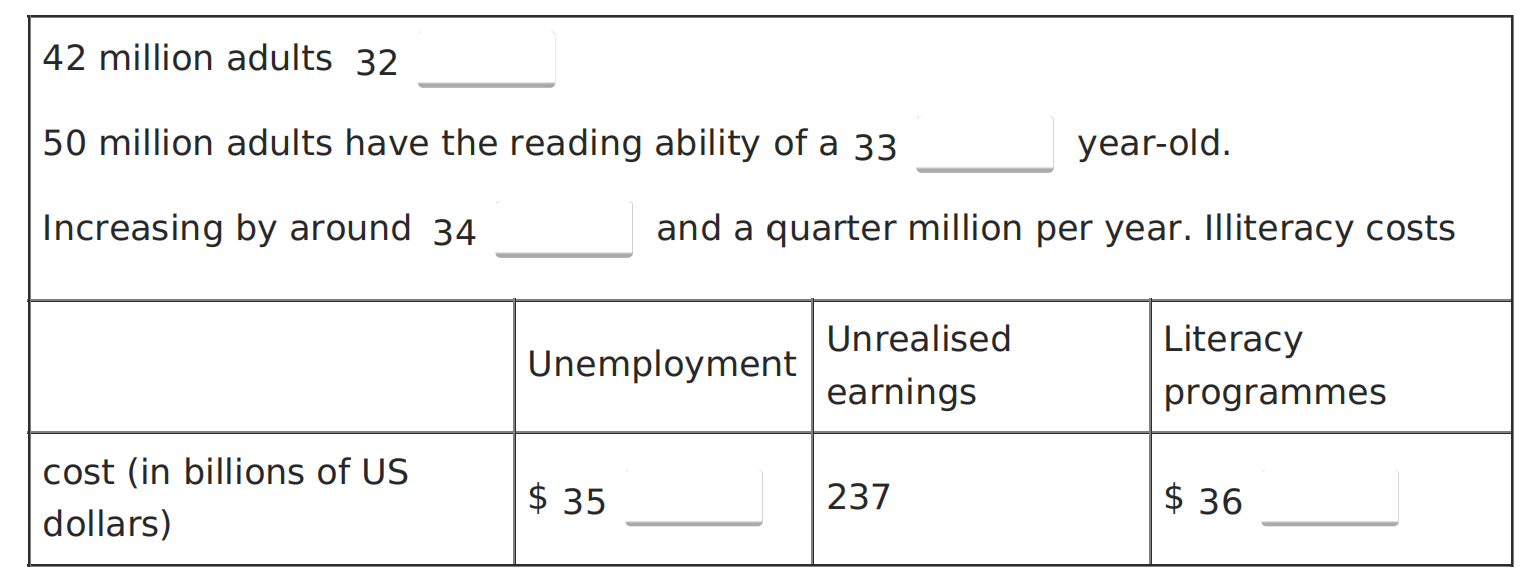
[02:04.66]In America alone, 42 million adults cannot read and 50 million can recognize so few printed words.
[02:13.90]They each have the reading ability of a ten-year-old frightening statistics indeed, but not as frightening as the trend suggested by current estimates, the number of illiterate adults is increasing by approximately two and a quarter million people each year and although global statistics have not been compiled as it suggests an extremely disturbing figure.
[02:39.66]Inevitably, this is having an impact on employment.
[02:44.10]In America the annual cost and welfare programs and unemployment compensation due to a literacy stands at six billion US dollars and an additional 237 billion a year in unrealized earnings is forfeited by people who let basic reading skills.
[03:05.25]There is also the cost of post school literacy programs which have been put in place in order to counter this increasing figure.
[03:14.38]A conservative estimate places the cost of these programs at 10 billion dollars each year and growing steadily.
[03:23.01]Moving on, I'd like to talk about some of the causes of this increasing illiteracy.
[03:30.94]Children were taught to read by first learning the alphabet then the sounds of each letter, how they blended into syllables and how those syllables made up words.
[03:43.33]They were taught that English spelling is logical and systematic, and that to become a fluent reader it was necessary to master the alphabetic code in which English words are written.
[03:55.69]To the point where the code is used automatically with little conscious thought given to it.
[04:01.52]And to make myself to you, I mean readers could sound out the letters, spelling them phonetically.
[04:08.48]Once a child learned this ability, attention could be turned to more advanced content.
[04:14.57]It seldom if I ever occurred to teachers to give children word lists to read or to make beginner level readers memorize whole words before learning the components of those words or to memorize whole stories as today's proponents of the whole language approach recommend.
[04:36.56]Several recent studies have found that 90% of remedial reading students and developed countries are not able to decode fluently, accurately and at an automatic level of response.
[04:50.64]The currently used whole language method was originally conceived then used in the early 1800s to teach the deaf how to read, a method which is long since being discarded by the teachers of the deaf themselves as inadequate and out murdered.
[05:10.02]English is an alphabetic language that when written uses letters to represent speech sounds when students were taught to read, they consciously identified the speech sounds and learned to recognize the letters used to represent them.
[05:30.39]They were then trained to apply this information to decode the names of unwritten words, understand their meaning and comprehend the information presented as a complete thought.
[05:43.42]The English language contains approximately half a million words. On these words, about 300 compose about three-quarters of the words that we use regularly.
[05:56.94]As I said in schools where the whole language method is taught, children are constantly memorizing sight words during the first three or four grades of school but I never taught how to unlock the meaning of the other 499 thousand seven hundred or more words.
[06:16.30]Whole language learning causes frustration, poor spelling and hostility towards reading.
[06:24.42]Very bright children who can't memorize long lists of words and retain their meaning are placed in special education.
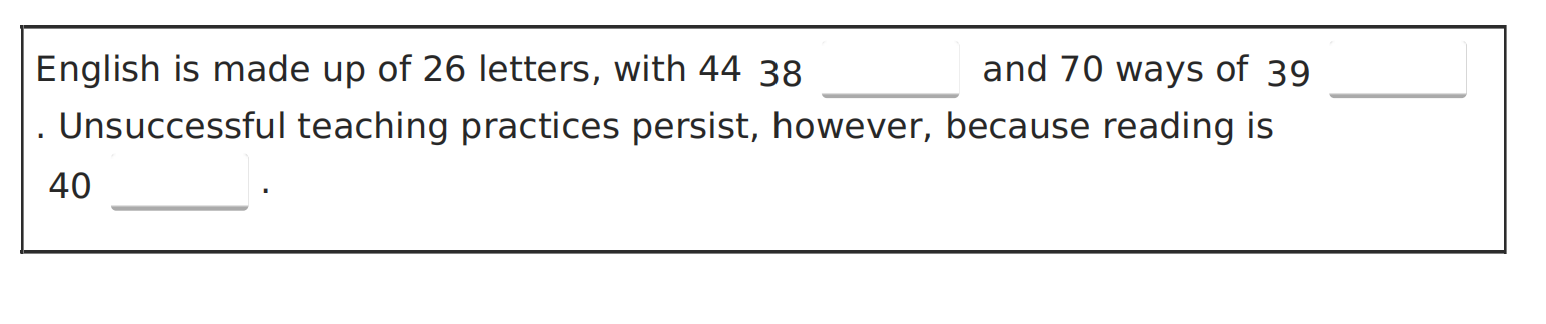
[06:31.78]When all they need is to be taught that 26 letters of the alphabet, the 44 sounds they make, and the seventy common ways to spell those sounds.
[06:44.51]Some researchers believe dyslexia and the symptoms of attention deficit disorder actually caused by this reversal of the normal learning sequence.
[06:56.43]So, why do faulty reading methods continue to be used?
[07:01.86]Well, in short, it's big business.
[07:06.54]The sale of instructional reading programs is big business today.
[07:11.06]Each year publishing companies compete for the adoption of reading programs and workbooks which have to be replaced annually concentrating on phonics would seriously reduce the cost of education.