[00:56.55]Tutor:Right?
[00:57.03]Aya.
[00:57.91]The last time we met, you decided to choose skills and attitudes in learning math as the focus of your research project.
[01:05.47]You were thinking of splitting it into two sections. Is that right?
[01:10.51]Aya:I decided to start by looking at people's attitude to math, and then go on to research how people actually solve different math problems.
[01:19.27]Tutor:Great.
[01:20.25]Now, what research methods did you use?
[01:23.73]Aya:I explored lots of different techniques and actually tried out things like sending out questionnaires, but then I opted for a different approach.
[01:32.81]I thought face to face interviews would be more appropriate, because you can look at things in more depth when you're actually with the person.
[01:41.19]Tutor:How many participants did you have?
[01:43.79]Aya:Quite a few which meant interviewing was pretty demanding work, 25 altogether, 14 men and 11 women.
[01:53.19]Tutor:How did you identify them?
[01:55.95]Aya:They were all students at this college.
[01:57.99]And what I did was send round a really short questionnaire by EMAIL, asking whether people like math and these 25 answered not at all, which is what I needed.
[02:09.53]Tutor:So you followed them up.
[02:11.13]Aya:Yeah,and arranged to interview them.Now, the first question I asked them was, how good do you think you are at math?
[02:19.57]I got these results, a pretty even split at either end of the continuum, 20 % for both good and poor and the majority in the middle.
[02:31.29]I should emphasize that for this, there were no distinct differences between men and women.
[02:36.65]Tutor:Did those figures surprise you?
[02:39.01]Aya:I wouldn't say.
[02:39.81]So what did shock me was how violently anti�maths as a subject they were.
[02:45.85]It wasn't what I'd expected at all.
[02:48.17]Tutor:I can imagine.
[03:41.37]Aya:Anyway, the next part of my interview asked about their experiences of learning maths and why they had become so negative about it.
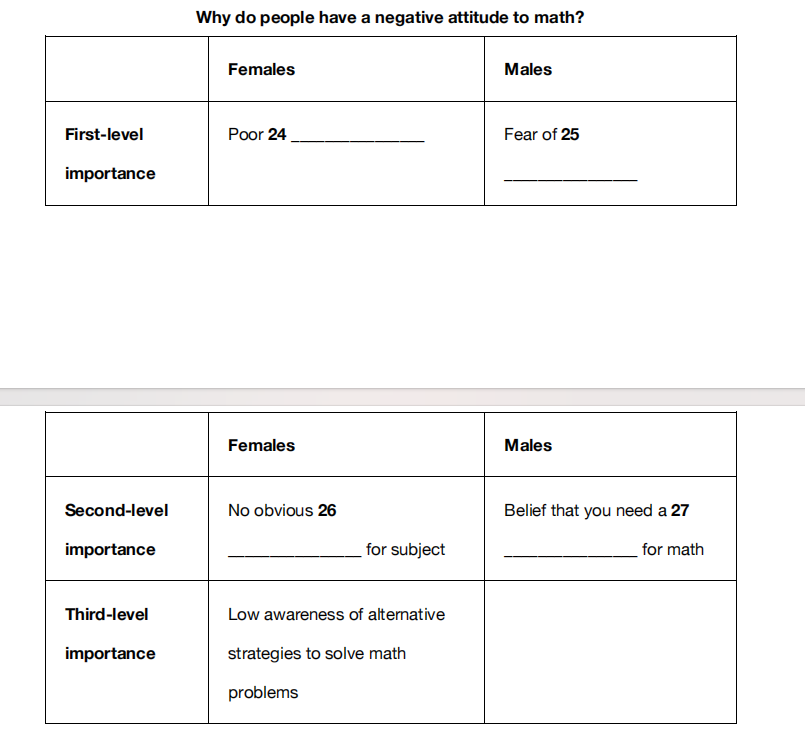
[03:50.69]I identified three different levels of importance as you can see in this table.
[03:56.69]Tutor:Do you mean the first row shows those points which were considered most serious?
[04:02.05]Aya:That's right.
[04:03.45]The second row, the second most important, and so on.
[04:08.41]I also showed the difference between female and male responses.
[04:13.16]Now, you can see that for the women, they thought bad teaching was mainly to blame for their dislike in math.
[04:20.16]Tutor:Didn't the men think that?
[04:21.64]Aya:No, they talked mostly about the fact that they were actually scared of numbers.
[04:28.68]Tutor:And some of these people consider themselves to be good at math.
[04:32.04]Aya:Yeah,interesting, isn't it?
[04:34.44]And then the problem for the women at the second level was the fact that they couldn't see what applications math had, what obvious ones, anyway.
[04:44.16]Tutor:Yeah,that's been my experience as well.
[04:47.72]Aya:For the men, they found problems because they had this strong belief that you have to be born with a talent, for the subject to be any good at math.
[04:56.48]Tutor:I've come across that quite often in my work, too.
[04:59.72]Aya:And then at the third level, it was striking that men and women have the same problem, which was that they weren't really aware of alternative strategies for solving problems.
[05:12.53]Tutor:Thanks.
[05:13.57]Now, what about the second part of your study, Aya?
[05:14.33]Aya:The method I used for my research was observation.
[05:21.61]Tutor:Of what?
[05:22.85]Aya:Of how different people solve math problems.
[05:27.05]Basically, I set them a problem and ask them to write down any workings out.
[05:33.62]I made notes on how they did it.
[05:36.50]Tutor:Good mathematicians.
[05:38.02]Aya:A mixture actually.
[05:40.28]Five successful and five less successful.
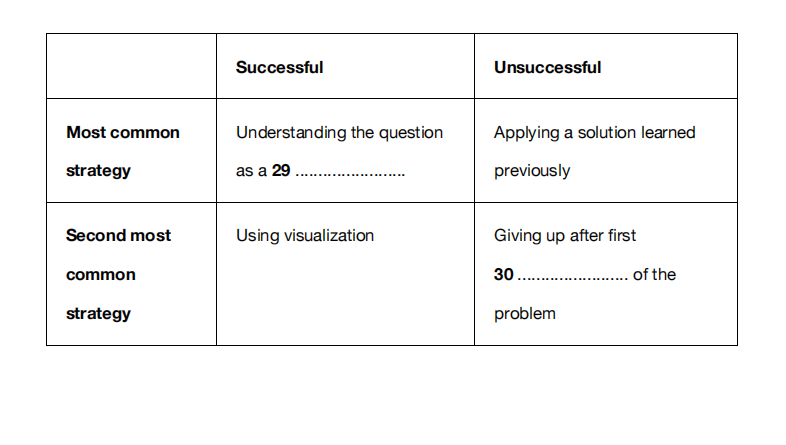
[05:43.38]Now, I found that the most common strategy used by the people who got the correct answers was that they attempted to comprehend the question taken as a whole.
[05:53.22]This obviously helped them a great deal.
[05:55.90]In contrast, with the way unsuccessful participants worked for them, the most common strategy was to take a solution which they had learned before and try to apply it.
[06:07.23]Tutor:Were there any other strategies?
[06:09.27]Aya:Yes.
[06:10.15]The second most common technique I saw used by the good problem solvers was visualization.
[06:16.03]Tutor:Wait, how interesting i've noticed that actually, how I work best and what about the weaker ones?
[06:23.50]Aya:Well, I have to say the strategy they used was to give up immediately after reading the question I'm afraid.
[06:31.58]Tutor:Well,that's extremely interesting, Aya.
[06:34.42]had you thought about that?