[00:49.94]P:Today the prison system is in crisis.
[00:52.22]Disorder and violence are the norm in many prisons.
[00:55.42]With us today is Jon Whiting to talk about how history could teach us a few things about running prisons more effectively and at less cost to the taxpayer.
[01:03.62]So Jon, tell us a bit more about the lessons we could learn from the past.
[01:07.86]Jon Whiting: Well, today we see prisoners behaving aggressively towards prison guards, who themselves struggle to maintain discipline in prisons.
[01:15.66]We are giving prisoners too many rights.
[01:18.26]Maybe we need to adopt prison systems used in past times to maintain better control in prisons.
[01:24.63]For one thing, prison systems in the past could definitely teach us about how to better control prisoners with fewer guards.
[01:32.65]I know it sounds too good to be true and a bit of a contradiction in terms, but certain prison designs from the past have done exactly this.
[01:41.40]In fact it was in the 18th century that the design for the first really effective prison was thought of.
[01:48.40]Even today the design is far superior to any modern prison building.
[01:53.20]The design was the idea of philosopher and social realist, Jeremy Bentham.
[01:58.37]Named the 'Panopticon' after the Greek 'pan' meaning 'all' and 'opticon' seeing, the design allowed a single guard to watch many prisoners at the same time.
[02:08.61]It was an amazingly clever invention.
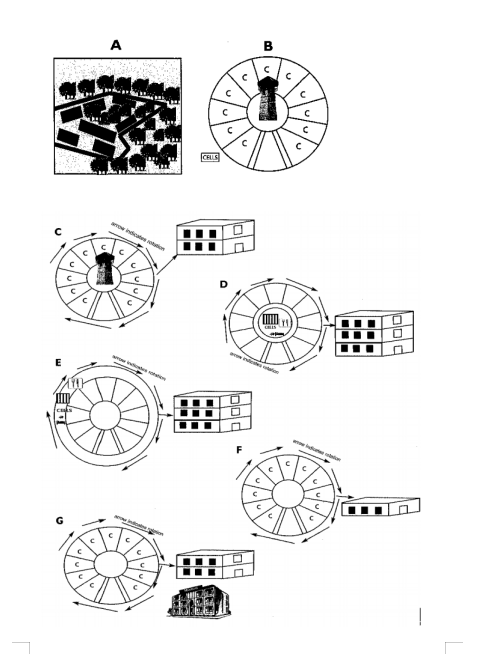
[02:12.20]Bentham's design had the form of a central guard tower around which the prison cells were grouped in a circular fashion, facing inwards towards the tower.
[02:21.32]Seen from a bird's-eye view, the design resembled a giant pie cut into segments, each triangular segment being an individual prison cell, with the watch tower at the centre.
[02:33.93]What made this design so clever was the fact that only one guard was needed to watch all the prisoners.
[02:40.49]As a result, fewer guards were needed, reducing cost and manpower.
[02:45.45]It also had the effect of making prisoners behave better.
[02:49.41]This was because whilst the guard could in theory see all the prisoners at any one time, they could not see him due to the way the prison was designed, So, manpower could be reduced to almost zero at times, if the guard wanted to take a break, as his prisoners would never realise they weren't being watched!
[03:45.16]Although Bentham's idea was never put into practice in his lifetime, in later years a very similar design was patented by William H, Brown and Benjamin Haugh in 1881.
[03:56.20]One of these, the 'Squirrel Cage' in Pottawattamie County only closed in 1969.
[04:02.96]It was one of 3 prisons designed by Brown and Haugh.
[04:05.96]Each had the unusual feature of revolving prison cells that moved around a central tower, like a wheel revolving on its axis.
[04:14.46]Bearing an obvious similarity to Bentham's Panopticon, the cells within the wheel-like structure were all also triangular in shape.
[04:22.50]Brown and Haugh's designs ensured that no personal contact between prisoners and jailers was necessary.
[04:29.07]However, they also allowed maximum security with minimum jailer attention, just like Bentham's original Panopticon design, in fact.
[04:38.63]The main difference between the three prison designs was in their size.
[04:41.95]The Pottawattamie County jail was constructed on 3 floors, whilst the Crawfordsville jail in Indiana was a 2-storey prison and the Gallatin Missouri jail only a 1-storey prison.
[04:56.23]The Pottawattamie County jail also had some extra buildings outside the perimeter of the prison cells.
[05:01.87]These buildings included the kitchen, jailer's accommodation as well as cells for female prisoners and more trusted inmates.
[05:09.79]All buildings now are disused as jails, and they function as museums to those interested in history and the purely curious.
[05:17.11]Any modern-day visitor can now see first-hand the signatures and dates of many of the prisons' infamous prisoners, which are carved into the prison walls.
[05:27.59]They can also marvel at the ingenuity of prison buildings that have never been equalled in practicality and design since they were first constructed over 100 years ago.
[05:37.89]In complete contrast to the preceding prison designs is the contemporary architecture of Norway's Halden prison.
[05:45.39]This, for me, exemplifies what is wrong with prisons today.
[05:49.15]More reminiscent of a holiday camp than a place of incarceration.
[05:52.75]Halden's prison buildings are surrounded by attractively landscaped areas.
[05:57.23]The idea is to provide a relaxing environment but it seems that the architects forgot that prison is meant to punish prisoners, not provide them with recreational facilities!
[06:07.51]I believe that the lenience exhibited towards prisoners today and the privileges that they enjoy are contributing to the disorder that we now see in prisons.
[06:16.91]Architects need to look to past prison designs for inspiration, not holiday brochures for luxury hotels!