[00:58.02]PHIL:That lecture from the visiting speaker yesterday was good, wasn't it?
[01:02.10]LUCY:
[01:02.10]Yeah.
[01:03.02]I learned a lot from her about ocean biodiversity.
[01:07.06]I've already done some reading on it, and I did an assignment on some of the problems associated with it last year, but I especially liked the way her lecture focused on more long-term issues.
[01:19.74]PHIL:Yes, things that aren't currently receiving widespread attention but are likely to be important in the future.
[01:27.06]That impressed me too.
[01:29.02]It wasn't exactly a feel-good conclusion because it's hard to see any real solution for a lot of the problems.
[01:36.02]LUCY:No, though she did point to where policy changes could be made to protect our marine and coastal environments.
[01:43.94]PHIL:Mm. But that's just at a national level.
[01:46.78]The examples she gave were at a more global level, and they really made it clear to me just how wide-ranging the threats to ocean biodiversity are.
[01:56.30]LUCY:Yes, me too.
[01:57.86]PHIL:The research project she described was impressive, wasn't it?
[02:01.90]I'd have thought it was quite unusual to have so many experts working together.
[02:06.74]LUCY:Yeah, and from such different backgrounds.
[02:09.78]Must have been a really exciting team to work with.
[02:12.86]I'd heard of a couple of them before - they were involved in research way back in 2009 warning about the dangers of ocean pollution.
[02:22.10]PHIL:But now people are much more aware of that, aren't they?
[02:25.38]LUCY:I suppose so.
[02:26.70]PHIL:Another thing about the research is that the team members came from all round the world.
[02:32.38]Though I suppose that's not unusual nowadays, now everyone can work remotely.
[02:37.54]LUCY:Right.
[02:38.62]I liked the way she didn't bombard us with figures - I mean, they were available, but she focused more on the general points they indicated.
[02:48.62]PHIL:Mm.
[02:48.62]And the description of improvements in systems used for tracking marine animals and things like robots were really interesting.
[02:57.46]LUCY:Yes, and her description of how robotics can be used to investigate threats to biodiversity.
[03:04.42]PHIL:Absolutely.
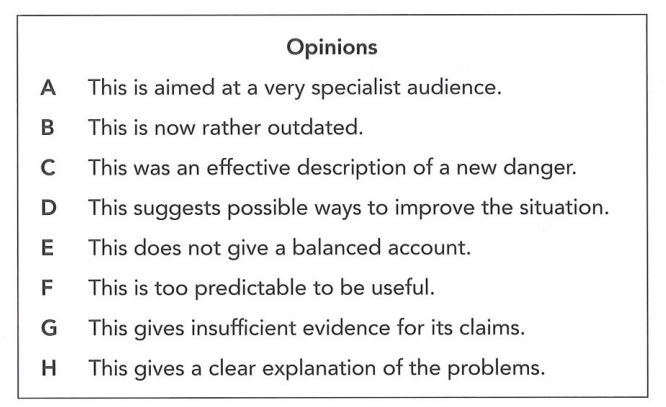
[03:59.57]PHIL:While you're here, can we talk about the list of resources we have to evaluate for the seminar tomorrow.
[04:06.05]I've had a look at them all, but it's been a bit of a rush.
[04:09.81]LUCY:Yeah.
[04:10.81]What did you think of that article on invasive lionfish?
[04:14.85]The one claiming they were expanding their habitat throughout the Mediterranean Sea.
[04:19.85]PHIL:Well, the writer went on about how dangerous they were in environmental terms, which is probably true, but he didn't really provide much information to explain why.
[04:31.74]LUCY:I know what you mean.
[04:33.30]PHIL:I watched the documentary on microplastics, at least I started to, but then I found it was made ten years ago so I gave up.
[04:42.58]LUCY:I watched to the end but you're right, it was showing its age.
[04:47.02]People had hardly heard of microplastics then, whereas now everyone knows about them and how dangerous they are.
[04:53.94]PHIL:Yeah.
[04:54.94]Did you listen to the podcast on ocean pollution?
[04:59.10]LUCY:Mm.
[04:59.10]I didn't get anything out of it though.
[05:01.26]Most of it was stating the obvious.
[05:03.14]PHIL:Yes, it mentioned pesticides and plastic and things, and it clearly made the point that they were a bad thing, but everybody knows that anyway.
[05:14.20]Did you read that book on coastal ecosystems?
[05:17.32]LUCY:The one by John Harper?
[05:19.32]Yes, I found it hard going at first, it went into a lot of detail about things like the effects of offshore windfarms and fish farms, but actually I ended up with a much better understanding of the issues.
[05:33.40]PHIL:Yes, I agree and I thought it was a well-written summary of those.
[05:38.33]And the diagrams helped a lot too.
[05:40.65]LUCY:The article on metal toxicity was way above my head, I didn't know anything about how metals from industrial emissions react in the ocean…and I still don't understand it.
[05:53.53]PHIL:I gave up reading after the first chapter - I just couldn't follow it.
[05:58.24]LUCY:That podcast on floating marine cities was interesting, though it presented a rather one-sided picture, I thought.
[06:06.36]PHIL:Yes, it focused on how this would benefit people and ignored the effects on the environment.
[06:12.84]LUCY:But anyway, shall we ...