[01:06.66]professor:: Hello, everyone.
[01:08.38] Before we continue with our lectures on the history of music and art, we'll be listening to Michael's presentation on how music and art are being used to help with the healing process in the 21st century.
[01:22.45]Michael, are you ready to begin?
[01:24.89]Micheal:: Yes, I think so.
[01:27.09]Thanks, professor.
[01:28.49] Right, good morning all.
[01:31.13] As professor McKinley just stated, I've been doing some research into the healing powers of art and music.
[01:39.61]I'd like to present my findings to you today.
[01:43.25] I intend to demonstrate the positive effects of music and art on patients, emotional, social, as well as physical, well‑being.
[01:53.25]Let's begin by going back in time to the most famous of nurses.
[01:57.77]Florence nightingale.
[01:59.85] Way back in 1860, Florence nightingale wrote in her notes on nursing that brightly colored flowers and art helped her patients to recover more quickly.
[02:12.20] Although her comments were viewed with skepticism at the time, we believe she was the first of many health professionals to state this.
[02:22.88]Over the following years, there were many other studies that tried to prove that a link between art, music, and health exists, but very few of them were strictly controlled.
[02:35.44]The results were variable and therefore unreliable.
[02:40.53] However, one American study was different.
[02:44.28]In the 1980 s some research took place into the effect of architecture on the recovery time of 46 patients who were in hospital for a gallbladder operation.
[02:57.11]Half of the patients were kept in hospital wards with windows overlooking some trees.
[03:03.07] The other half were left in rooms that faced onto a brick wall.
[03:08.21] It was found that the ones with a nice view left hospital a day earlier, and needed fewer painkillers.
[03:16.06]This study was groundbreaking as it was the first that used controlled conditions that could be measured statistically.
[03:24.18] And without bias.
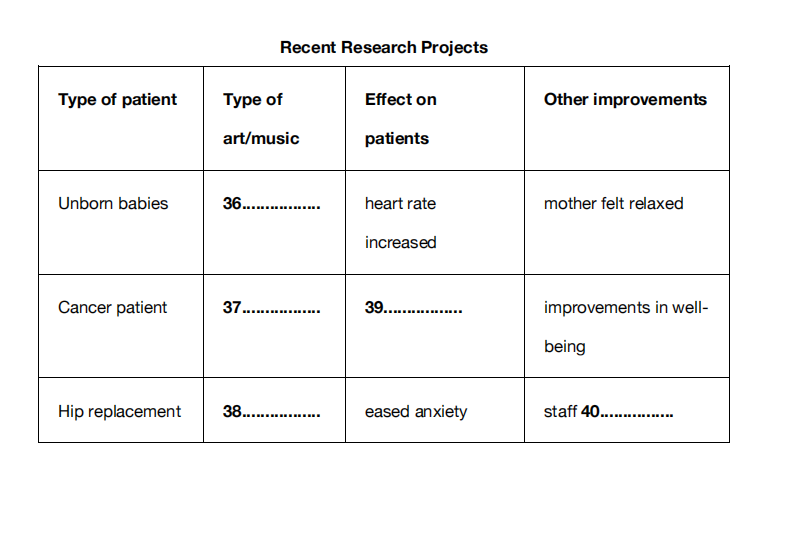
[03:30.63]Now I'd like to bring you up to date and take a closer comparative look at three research projects on three very different types of patient.
[03:38.95] The first monitored the health of unborn babies in the study which took place at a hospital in London, babies were played live music, and their heart rates were monitored.
[03:52.96]A healthy baby's heart would beat around 110 to 160 times a minute.
[03:59.64] But researchers found that their heart rate increased by up to 15 beats a minute, on average, without the mother's pulse changing.
[04:08.80]This is a good sign that the baby is healthy. In addition, the mothers that took part in the survey also said they felt more relaxed.
[04:19.05]Another study looked at cancer patients who were visiting as day patients to receive their chemotherapy treatments.
[04:26.96]They were treated in a room that had artistic pictures hanging on the wall.
[04:32.08]The pictures were changed each week, so that the patients would not have to look at the same ones week after week.
[04:39.24]When questioned afterwards, patients said that they felt less pain because the images helped take their mind off the treatment they were receiving.
[04:48.91]They also noted general improvements in their well‑being.
[04:53.85]Finally, the last study analyzed the treatment of a group of elderly patients who were in hospital to have a hip replacement operation.
[05:03.73]They needed to stay for around 10 to 14 days.
[05:08.44]The researchers played them 30 minute tracks of soothing classical music, but not every day and then monitored their progress using a questionnaire.
[05:20.19]When asked to rate how they felt both with and without music, the patients consistently stated that they felt less anxious on the days when they had the music playing.
[05:32.55]There was a second unexpected but completely understandable result from the research.
[05:38.70]The staff liked the music so much that they said they too felt happier, and that they would be less likely to leave the hospital for a job elsewhere if it were to continue.
[05:50.93]Now that has to be a good thing, which will also have a positive effect on the quality of the treatment patients receive.
[05:59.09]In conclusion, I'd like to bring to you.