[00:55.78]TUTOR:Thanks for coming along, Nadia and Fergus.
[00:58.70]TUTOR:So this is a chance for you to give us some feedback about different aspects of your course.
[01:04.98]TUTOR:What would you like to begin with?
[01:07.10]NADIA:I've enjoyed the sessions on food safety.
[01:10.06]NADIA:There was some information there that I found really surprising, although some was stuff I knew already, like the rise in rates of obesity.
[01:18.34]FERGUS:Yeah.
[01:19.54]FERGUS:that's been in the news a lot.
[01:20.75]FERGUS:But I hadn't realised that unsafe food causes more than 200 different diseases.
[01:26.43]NADIA:No, I'd no idea it was that many.
[01:29.59]NADIA:And speaking of diseases, I knew resistance to antibiotics is on the increase, but I didn't know why.
[01:37.51]FERGUS:…that it's partly because when animals are treated with antibiotics then consumed by humans, the antibiotics get into the food chain.
[01:45.84]FERGUS:I had no idea about that either.
[01:49.20]NADIA:Then the sessions provided a lot of information about plastic pollution from food packaging in the ocean, but I think that most of us were already aware of that.
[01:59.08]FERGUS:Yeah.
[01:59.96]FERGUS:But I thought we could have done more on how much food is thrown away unnecessarily through fear of it being out of date, that was only mentioned in passing.
[02:09.30]TUTOR:OK, I'll bear that in mind.
[02:11.90]TUTOR:What did you think about the sessions from visiting lecturers, Fergus?
[02:16.62]FERGUS:For me the most interesting one was about that project to prevent companies giving incorrect information to consumers about food.
[02:24.50]TUTOR:Ah, food fraud, yes.
[02:27.30]FERGUS:I thought it was really good to address a problem that's faced by so many different groups - people with special religious rules, as well as vegetarians and vegans.
[02:37.09]NADIA:And those with allergies.
[02:38.85]FERGUS:Yeah.
[02:39.69]FERGUS:And another thing, we've had effective ways of analysing DNA for some time now and these can easily be applied to analysing food.
[02:48.49]FERGUS:But what the researchers succeeded in doing was to ensure that these tests were carried out at different stages in the food's journey from the producer to the consumer.
[02:57.81]NADIA:So they knew that the food actually came from the place it was supposed to, and had the ingredients it was meant to.
[03:04.41]FERGUS:Exactly.
[03:05.41]FERGUS:So customers can be confident about what they buy.
[03:08.85]NADIA:And the researchers had a good system for publicising their findings too.
[03:13.21]FERGUS:Well, I thought there were some problems with that, actually.
[03:17.21]TUTOR:OK.
[03:18.33]TUTOR:And do you have any recommendations for new topics that we could include in the course?
[03:23.90]NADIA:Well, I'm interested in how crop yields can be increased without damaging the environment.
[03:29.58]FERGUS:But we've already done quite a bit on that - but not so much on the seafood industry, where stocks are in danger of being overexploited as a food source unless we can find ways of keeping stocks up.
[03:41.50]NADIA:Yes, that'd be a good topic.
[03:44.58]NADIA:And I'm interested in the idea of a personalised approach to diet, now we have the technology to analyse exactly what individuals need.
[03:53.94]FERGUS:That sounds more like a medical topic than food science.
[03:57.70]NADIA:OK.
[03:58.96]NADIA:What about sessions on the variety of food and eating habits around the world?
[04:04.28]NADIA:That's very relevant nowadays.
[04:06.20]FERGUS:Yes, I think the whole class would be interested in that.
[04:09.56]NADIA:Then there's technological stuff, things like 3D printing of food and smart packaging.
[04:16.16]FERGUS:Mmm - maybe too specialist.
[04:56.95]TUTOR:Now, I'm particularly interested in your project - the one where you developed a new food product.
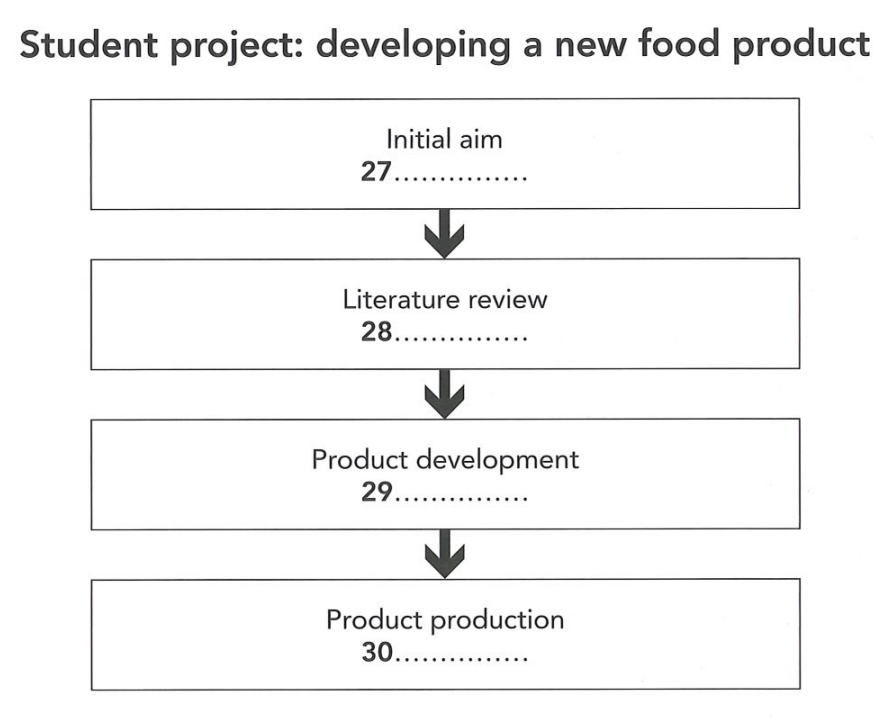
[05:03.71]TUTOR:So talk me through the stages.. first you had to decide on your initial aim.
[05:09.95]FERGUS:We decided we wanted to create something people could eat on the go rather than in a restaurant.
[05:15.95]NADIA:Yeah so we chose falafel, which was originally a Middle Eastern snack.
[05:21.35]FERGUS:We made up our minds about that pretty quickly.
[05:24.27]FERGUS:I know some students found it a lot harder to choose, and wasted a lot of time.
[05:29.51]NADIA:Then we had to do the literature review.
[05:29.75]NADIA:We hadn't done one of these before so the handout with advice for the project was very useful here.
[05:38.79]FERGUS:Yes, especially the advice on how to present the information.
[05:43.75]FERGUS:Then product development, actually deciding what we'd use to make the falafel, and for me the interesting thing about that was that we wanted it to be something a bit different from an ordinary falafel.
[05:57.75]NADIA:We really made the right choice when we finally decided to use jackfruit, even though it wasn't something that either of us had ever tasted before.
[06:06.62]FERGUS:Yeah, like the name tells you, it's a fruit but actually it's really good in savoury dishes.
[06:13.78]FERGUS:The product production, working out how to make the falafel, was harder than I expected because I'd never made them before.
[06:21.82]NADIA:It was mostly trial and error.
[06:24.50]NADIA:We started off with the basic recipe and then experimented and when it went wrong …
[06:30.42]FERGUS:…which it did a lot of the time …
[06:33.22]NADIA:… we just moved on and kept adapting it and in the end it turned out fine and we had a lot of fun.
[06:40.06]FERGUS:We did!
[06:41.18]TUTOR:Thank you.
[06:42.30]TUTOR:Well, your project was a very good...